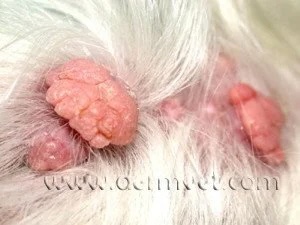
Also Known As: Nodular Sebaceous Hyperplasia
Transmission or Cause
A benign tumor of the oil gland (sebaceous) cells of the skin. Although these tumors are commonly called "old dog warts" due to their appearance, they are not true warts as they are not viral-induced.
Affected Animals
Most common in middle-aged to older dogs, especially terriers, poodles, cocker spaniels, and miniature schnauzers.
Clinical Signs
Single to multiple raised, hairless, lobulated white to pale pink skin or sometimes pigmented skin masses which may ooze an oily white material. Masses range in size from ¼" – 1" in diameter. Tumors occur most commonly on the trunk, legs, feet, or face. They usually cause no bothersome symptoms unless they become traumatized or secondarily infected, in which case the dog may lick or chew at the lesions.
Symptoms
See Clinical Signs.
Diagnosis
Most commonly diagnosed by clinical presentation, but definitive diagnosis requires a biopsy, which reveals a benign accumulation of neoplastic sebaceous cells.
Prognosis
Good, as these tumors are benign, however, new tumors tend to occur as the dog ages.
Treatment
In most cases, aggressive treatment is not needed, as these are cosmetic lesions. However, lesions that grow, change, or bother the dog should be removed and biopsied. Surgical removal is curative but new nodules often continue to form elsewhere as the dog ages. In dogs with numerous tumors, oral retinoids (ie. isotretinoin) may slow the growth of nodules and decrease the formation of new tumors.