Transmission or Cause
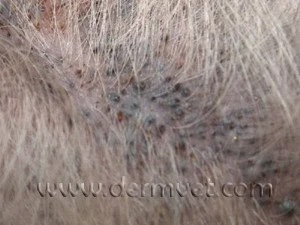
A breed-related acne-like keratinization disorder causes dilation of hair follicles on the back of miniature schnauzers.
Affected Animals
Young to middle aged miniature schnauzers.
Clinical Signs
In mildly affected animals, the only sign is the formation of asymptomatic comedones (blackheads) which are dilated hair follicles on the midline of the back. In more severely affected dogs, secondary bacterial infection may develop, causing crusts, pimples, hair loss, and itching.
Symptoms
See Clinical Signs.
Diagnosis
Breed and clinical signs are suggestive, but other causes of comedones such as bacterial infection, demodex, and dermatophyte (ringworm) need to be ruled out with skin scrapings and cytology, and possibly fungal cultures. Additionally in older dogs, hormonal diseases such as Cushing's disease and hypothyroidism can also cause comedones and may be diagnosed by blood testing.
Prognosis
Good, as this is a cosmetic disorder in most dogs that can be controlled (but not cured) with symptomatic topical therapy.
Treatment
In mildly affected animals, topical treatment with human acne pads or benzoyl peroxide gel periodically may be helpful. Antiseborrheic shampoos (sulfur/salicylic acids or, in severe cases, benzoyl peroxide) may be helpful for more extensive lesions. Treatment of any secondary bacterial infection with antibiotics is also important. Severely affected dogs may benefit from oral retinoids (ie. acitretin).