Transmission or Cause
Erythema multiforme (EM) is an immune-mediated disease in which the immune system or an unusual reaction to a drug or other foreign protein in the body triggers the destruction of cells in the skin and sometimes the mouth and other mucous membranes. Potential triggers for this disease are numerous and include idiosyncratic reactions to medications such as antibiotics and anti-inflammatories, infections, tumors, and even food allergies. In up to 25% of cases, an underlying cause cannot be identified.
Affected Animals
This is an uncommon disease in dogs and cats and can occur at any age, although older animals may be predisposed.
Clinical Signs
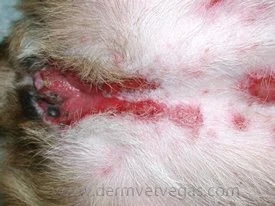
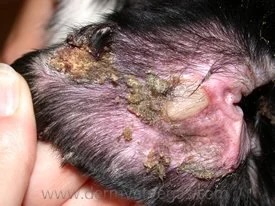
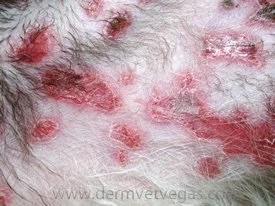
Erythema multiforme causes reddish bumps and blisters which can spread outward, creating ulcerations or round "bullseye" lesions (red circles with a central white area). Areas of the body that can be affected include the skin, the footpads, the mouth, ears, and around the vulva and anus. Severely affected dogs may be lethargic or have a fever and may be painful.
Symptoms
See Clinical Signs.
Diagnosis
Definitive diagnosis is made by obtaining multiple biopsies of affected areas for pathology analysis, which reveals single-cell to full-thickness necrosis (death) of the epidermis/skin cells. Additionally, a careful history and examination (including labwork, urinalysis, and in some cases x-rays and ultrasound) must be obtained to identify possible immune triggers such as prior drugs, infections, or tumors. If no obvious causes are found, a hypoallergenic diet trial may be recommended to evaluate and treat possible food allergies.
Prognosis
The prognosis is typically good to guarded, depending on the severity of disease and if an underlying cause can be addressed.
Treatment
It is important to identify and address any possible underlying causes, ie. if a drug reaction is suspected, the drug must be discontinued. Some cases of erythema multiforme may be mild and resolve spontaneously in a few weeks. In severe cases, immunosuppressive medications such as steroids or cyclosporine may be needed to stop the immune destruction of the skin; once the disease is in remission, the immunosuppressive medications may eventually be able to be slowly tapered and stopped after several months. Rarely, lifelong immunosuppressive therapy may be needed to maintain remission.
Prevention
There are few recommended measures for prevention. Dogs suffering from boredom or from the stress of being left alone for too long should be given a more stimulating and socially interactive environment.